Eli Altman has been naming things for most of his life. At age 6, he helped his father, Danny Altman, the founder of the San Francisco branding consultancy A Hundred Monkeys, on a naming project for the toy store FAO Schwarz. He has named 400 companies and brands since and joined his dad’s business in 2002.
But a couple of years ago, Altman started noticing what he saw as a distasteful trend: a wave of nonsensical names. Whereas the rules of English usage dictate that an e or an o usually precedes an r, entrepreneurs were starting companies with names such as Flickr, Socializr, and Touristr. Others were doubling or even tripling their o’s, i’s, and u’s — as in Zooomr, Rowdii, Yuuguu, and even Oooooc. With the rise of the Internet, names made of words that mean something, like Apple Computer, went out of favor. “Everyone wants these short, catchy names,” says Altman.
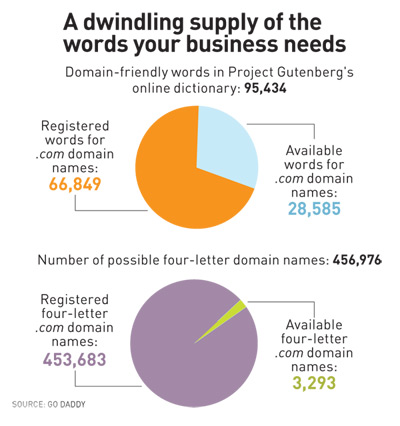
Web addresses are cheap — less than $10 a year in most cases — and trillions of them are still available. The problem is that short, pronounceable names ending with the popular .com extension are increasingly rare. “All the normal words in spoken English are taken,” Altman says. “Any short combination of letters and numbers is taken. Anything good under six letters is taken.” The result has been a proliferation of silly-sounding company names, with a recent trend toward handles that sound as if they might have come from science fiction. (One software company set up a website that challenges readers to discern between companies and Star Wars characters. For instance, Sebulba is from the fictional planet Malastare; Oyogi is a software maker in Raleigh, North Carolina.)
Some 80 million .com domain names are currently registered, a bit more than 800 times the number of domain-friendly words in Project Gutenberg’s online dictionary. Registered names proliferated after Google introduced its automated advertising system, AdSense, in 2003. The service made domain speculation — or domaining — a much more profitable business, allowing domainers to buy names and hold on to them indefinitely while making money with advertising.
Today, millions of names are available on auction sites such as Sedo.com and SnapNames.com, at prices that range from a few hundred dollars to hundreds of thousands of dollars. ZX8.com was recently on offer for $330, while Mouse.com was going for $350,000.
What should companies that still hope to snag unclaimed names do? Altman says there are plenty of words available to go along with extensions like .net. But most consumers expect for-profit companies to have .com names. “Dot-com is just where customers’ minds are,” says Bob Parsons, founder of Go Daddy, the largest registrar of domain names. Christopher Johnson, author of the blog The Name Inspector, says that longer domain names can be just as effective as shorter names so long as they have “recognizable parts,” like Craigslist or Photobucket.
As available names dry up, entrepreneurs are scrounging around for what’s left. David Rusenko, the founder and CEO of a website and blog-building service, wrote a software program that randomly generated short, pronounceable names available for purchase. A lot of the names the program spit out contained multiple z’s, but Rusenko found his name, Weebly, within a few hours. (The runner-up was Moovo.) Weebly “sounds more like a kid’s toy,” one blogger wrote. Rusenko disagrees. “It’s short, it’s brandable, and people remember it,” he says.