Category Archives: Uncategorized

TweetDeck Arrives on Android

Starting this Thursday, popular social media management tool TweetDeck will be available as an Android app. The company is opening its beta program in the morning, and we were lucky enough to get our hands on a copy tonight.

We’ve tried other Android apps that have promised varying degrees of functionality and features for social media work and play; we’ve experienced varying degrees of satisfaction so far with all of them.

The TweetDeck app for Android is still “very beta,” a.k.a. lacking the polish you’d expect from a completely finished application. We tried playing around with it a bit tonight; while we’ll be delighted when more mature builds are available, we still think the app has breathtaking potential.

It integrates Facebook, Twitter, Buzz and Foursquare accounts into a single application. Updates are color-coded and presented in a single, blended column. There’s also a “Me” column for reviewing all your Twitter @replies and comments and like for your Facebook posts.

To give you an idea of what the app will look like, here are the signin and Home screens:

And here’s what a Foursquare venue screen and Twitter profile page look like:

Overall, the UI is clean and optimized for mobile displays — and the way updates are pulled is easier on battery life than having a constantly running, real-time stream of data.

And we’ve got to hand it to the developers and designers at TweetDeck for giving Android users even more fun and useful features than are currently available on the iPhone version of TweetDeck, which doesn’t yet support Foursquare or Buzz. But this Android app is a clear signal of where the company’s Apple-focused applications will be headed.

In future iterations of the app, TweetDeck hopes to add improved map performance, better handling for multiple Twitter accounts, video upload capabilities and better integration with Android hardware.

Check the company’s website in a few more hours for details on how you can be part of its Android beta program, and definitely let us know what you think of the app in the comments.


1 in 10 UK web users visit Twitter. 1/2 the number in Indonesia, Brazil, Venezuela

Twitter.com is now used by 93 million people worldwide, according to the latest data from comScore. Bear in mind that this is data based purely on visits to the Twitter website, rather than access from third-party applications, and that comScore’s metrics are more indicative than accurate. But patterns on growth are particularly interesting.

Twitter Bird - Paper Toy
Photo by Rosaura Ochoa. Some rights reserved.

Figures for June show the number of monthly users up 109% from June 2009 to 92,874,000 with the biggest growth in Latin America and Asia Pacific. Latin America has 15.4m users and Asia Pacific 25.1m, while Europe has 22.5m and North America 24.9m.

Growth was slowest in North America, at 22% year on year, where Twitter is already established. Latin America saw traffic to the Twitter site increase 305% and Asia Pacific 243%.

Despite the high profile of Twitter in English-speaking countries its penetration by country was outperformed by new markets. In New Zealand 7.5% of web users access the site, compared with 10.9% in the UK and 11.9% in the US.

Indonesia proportionally has the highest level of use with 20.8%, Brazil with 20.5% and Venezuela with 19% – possibly spurred on by President Hugo Chavez’s recent enthusiasm for the platform.

Again, these figures do not include access from apps like Echofon, Tweetie (now Twitter’s official app) or TweetDeck, but comScore does have figures for Twitter.com access on smartphones: In the US, 8.3% of smartphone users access the site, with 5.7% in the UK and 3.4% in Germany.

comScore’s Graham Mudd, vice president for search and media, said 75% of web users now access social networking sites each month. “”That makes it one of the most ubiquitous activities on the web. As users around the world have become acquainted with connecting and expressing themselves through social media it has created an environment where new media like twitter can emerge globally in a relatively short space of time.”


Six Secrets to Creating a Culture of Innovation – Tony Schwartz – Harvard Business Review

When IBM recently polled 1500 CEOs across 60 countries, they rated creativity as the most important leadership competency.

Eighty percent of the CEOs said the business environment is growing so complex that it literally demands new ways of thinking. Less than 50 percent said they believed their organizations were equipped to deal effectively with this rising complexity.

But are CEOs and senior leaders really willing to make the transformational moves necessary to foster cultures of real creativity and innovation?

Here are the six fundamental moves we believe they must make. In all my travels, I’ve not yet come across a single company that systematically does even the majority of them, much less every one.

  1. Meet People’s Needs. Recognize that questioning orthodoxy and convention — the key to creativity — begins with questioning the way people are expected to work. How well are their core needs — physical, emotional, mental, and spiritual — being met in the workplace? The more people are preoccupied by unmet needs, the less energy and engagement they bring to their work. Begin by asking employees, one at a time, what they need to perform at their best. Next, define what success looks like and hold people accountable to specific metrics, but as much as possible, let them design their days as they see fit to achieve those outcomes.
  2. Teach Creativity Systematically. It isn’t magical and it can be developed. There are five well-defined, widely accepted stages of creative thinking: first insight, saturation, incubation, illumination, and verification. They don’t always unfold predictably, but they do provide a roadmap for enlisting the whole brain, moving back and forth between analytic, deductive left hemisphere thinking, and more pattern-seeking, big-picture, right hemisphere thinking. The best description of the stages I’ve come across is in Betty Edward’s book Drawing on the Artist Within. The best understanding of the role of the right hemisphere, and how to cultivate it, is in Edwards’ first book, Drawing on the Right Side of the Brain.
  3. Nurture Passion. The quickest way to kill creativity is to put people in roles that don’t excite their imagination. This begins at an early age. Kids who are encouraged to follow their passion develop better discipline, deeper knowledge, and are more persevering and more resilient in the face of setbacks. Look for small ways to give employees, at every level, the opportunity and encouragement to follow their interests and express their unique talents.
  4. Make the Work Matter. Human beings are meaning-making animals. Money pays the bills but it’s a thin source of meaning. We feel better about ourselves when we we’re making a positive contribution to something beyond ourselves. To feel truly motivated, we have to believe what we’re doing really matters. When leaders can define a compelling mission that transcends each individual’s self-interest, it’s a source of fuel not just for higher performance, but also for thinking more creatively about how to overcome obstacles and generate new solutions.
  5. Provide the Time. Creative thinking requires relatively open-ended, uninterrupted time, free of pressure for immediate answers and instant solutions. Time is a scarce, overburdened commodity in organizations that live by the ethic of “more, bigger, faster.” Ironically, the best way to insure that innovation gets attention is to schedule sacrosanct time for it, on a regular basis.
  6. Value Renewal. Human beings are not meant to operate continuously the way computers do. We’re designed to expend energy for relatively short periods of time — no more than 90 minutes — and then recover. The third stage of the creative process, incubation, occurs when we step away from a problem we’re trying to solve and let our unconscious work on it. It’s effective to go on a walk, or listen to music, or quiet the mind by meditating, or even take a drive. Movement — especially exercise that raises the heart rate — is another powerful way to induce the sort of shift in consciousness in which creative breakthroughs spontaneously arise.

These activities are only possible in a workplace that doesn’t overvalue face time and undervalue the power of renewal.

Google and Apple prepare for mobile advertising battle | Media | The Guardian

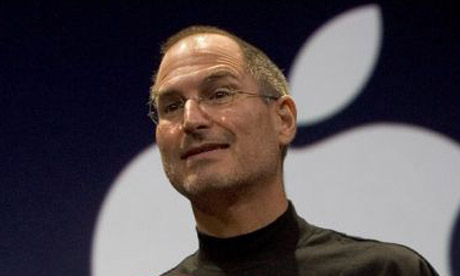
Steve Jobs

In early June, Steve Jobs demonstrated iAds in front of Apple developers in San Francisco. Photograph: David Paul Morris/Getty Images

British mobile users will soon find themselves embroiled in the epic confrontation taking shape between Apple and Google. iAds, Apple’s bid to run advertisements inside apps, is expected to make its UK debut in September. Separately, Google has adopted what its chief executive, Eric Schmidt, calls a “mobile first” approach, prioritising investment in a medium that has become “fundamental to everything we do”.

With the iPhone moving into mass market territory and the iPad selling 200,000 units a week, Apple’s decision to start selling mobile advertising seems likely to concentrate a few media minds.

In early June, Steve Jobs demonstrated iAds in front of Apple developers in San Francisco. The ad he showed off was a work-in-progress by Nissan. The demo, which included a 15-second video, an interactive application and a form to sign up for a competition, didn’t quite live up to Jobs’s aim of “trying to combine the emotion of video with the interactivity of the web”. But it was slick. In the future, Jobs promised, iAds would bring in the revenue that would allow developers to continue producing “free and low-cost apps to delight users”.

There are early signs that mobile advertising, like everything else touched by Cupertino’s genius, will turn to gold. During the eight weeks leading up to the presentation in San Francisco, Apple sold $60m-worth of iAds to the likes of Unilever and Disney. This compares with the $250m mobile online display revenue generated across the whole of 2009 in the US.

For media owners, there are two major problems with Apple’s ad model, which the analyst Toni Sacconaghi of Bernstein Research suggested in a recent report has the potential to become an $800m-a-year business within the next year.

First, Apple’s approach threatens to reduce media owners to the status of “developers” alongside tens of thousands of competitors. The second problem is that Apple’s business model, like Google’s, reduces media owners’ involvement in advertising markets to a minimum.

Mobile giants

Apple and Google already own the world’s two largest mobile ad networks. Both are already selling ads directly to advertisers. Advertisers, for their part, aren’t paying to reach mobile users attracted by a specific media company. Instead, in the case of iAds, they pay Apple to reach broad swaths of iPhone and iPad users who share common demographic characteristics.

In order to stitch together these communities of users, Apple has been analysing the purchasing history of its 150 million iTunes account holders worldwide who also use iPhones and iPads. Its own hardware produces a separate stream of data about what users do, and where and how they do it. Notably, the privacy policy associated with the iPhone 4 allows Apple, for the first time, to collect anonymised real-time location data on its users.

How much of this data will Apple share with advertisers and publishers? “We talk to Apple a lot,” says one publisher. “But we haven’t had that conversation yet.” The ad industry seems similarly uncertain. Michael Collins, the chief executive of Joule, a WPP-owned mobile agency, recently told Business Week that data sharing is “the question that many of us in the industry are very curious about“.

Google, too, is forging ahead, but in a different way. On the mobile web, it continues to emphasise lead generation rather than branding. Ian Carrington, director of mobile ad sales for Google Europe, Middle East and Africa, sketches out a scenario in which a mobile user is reading a book review on a handset in a cafe. “The accompanying ad will understand its context,” he says. “It will know what book is being discussed in that review. He adds: “You’ve also got GPS in most smartphones now, so your handset can tell you that this book is £5.99 in a shop 100 yards away, and £4.99 in a shop a mile away.”

Google, Carrington says, already knows how to do “the contextual part” of a scenario like this. “We’re still working on the location-based bit,” he adds. Yet the bottom line is that Google’s results-based approach will probably yield small revenues on the mobile web, just as it did on the desktop web.

Despite different approaches to advertising, one thing unites Apple and Google. Both companies want to hold on to a relatively large proportion of the ad revenue they generate. Apple, for example, proposes to pass on to developers 60% of the revenue generated by iAds. Google continues to suggest it passes on to publishers “at least 50%” of the revenue generated by ads it runs next to publishers’ content. These levels of commission will look high to anyone who recalls the 15% commission that used to go to media agencies for bringing in advertising for publishers.

There’s a further reason for publishers to be wary about the mobile web. As it turns out, Apple and Google plan to take a large slice of what, by anyone’s standards, is a very small pie. Last year, the latest in a series of years dubbed the “year of mobile advertising” by industry boosters, advertisers spent a mere £35m trying to reach British mobile users, according to Enders Analysis. That’s 1% of what advertisers spent on all digital advertising and, as Benedict Evans, a consultant at Enders Analysis, points out, less than the £50m he estimates Britons shelled out last year to have pornographic images texted to their handsets.

In the words of one publisher, the cumulative effect of these challenges is a “cautious” and “risk-averse” approach to publishing on tablets and handsets.

Others take a more positive view: Matt Kelly, digital content director at Trinity Mirror‘s national papers, says Apple has the upper hand “because they’re first into the market, they’ve done all of the development, all of the creative hard work”. “They’re reaping that reward,” he adds. “At the moment, content producers are at the mercy of great technology innovators. But it won’t stay that way forever. We may see a swing towards publishing content on Android if Google’s business terms become more attractive.”

Not a bad deal

Kelly is also wary of the argument that Apple and Google are skimming off too much mobile ad revenue. “The overheads at Trinity Mirror’s newspapers are 75% of revenue – for paper, ink, transport and so on. If someone comes along and says, we’ll replicate the revenues, but the bulk of your costs will be 40%, it’s not automatically a bad deal.”

Kelly remains confident about the value of content: “Technology will become commoditised and homogeneous, more open for third parties to come in and innovate and copy. The profits for platforms will decline and the profits associated with content will increase.”

Steve Pinches, lead product development manager at ft.com, says that Apple wants to use iAds to sustain a “huge long tail of apps that really have no easy way of monetising themselves”. Big media is different, argues Pinches. “We have very deep relationships with our advertisers that have been formed over years and years,” he says. “We also have an incredibly deep relationship with our readers.”

Evans also sees positives in Apple’s pricing of iAds. “They’re trying to catalyse the market,” he says. “If they’d gone out and said this is going to be cheap, advertisers would have carried on with their small experimental budgets. “But Apple has told advertisers they’re not spending $80,000 on another experimental campaign. Instead they’re each going to spend a minimum of $1m on each iAds campaign.”

Rupert Murdoch thinks the iPad “may well be the saving of the newspaper industry“. Yet Apple would like to claim the lion’s share of profits from the mobile web by charging a high price for its hardware. By contrast, Schmidt at Google foresees a future in which handsets and airtime are free, subsidised by advertising.

Both Apple and Google need what Jobs describes as “free and low cost” content that engages users and attracts advertisers. On the mobile web, the task facing media owners is to figure out how much revenue they can wring out in return.

What Google’s Nexus One Can Teach Us about E-Commerce

The Nexus One might be Google’s most extraordinary flop yet.

The phone itself was great, with excellent hardware and functionality, but the e-commerce strategy Google attempted to employ failed miserably, with their online store closing less than eight months after opening.

But as with any great success or failure, a lot can be learned by studying what they did. There’s plenty to study too, given the intense media coverage the Nexus One got from the time it was announced until after the store closed last month.

Here are some important lessons Google has offered through their own process of trial and error.

Excellent Customer Service at Launch is Vital

When the Nexus One (N1) came out, Google only offered customer support online, primarily through their user forums and online knowledge base. There was no phone number or other contact method available. It was the same system they offered for most of their products, and it seemed to be working fine, so they figured, “Why change it?”

But most of those products didn’t cost $530.

When you’re using a free app, or even one that costs $50-$100 per year, you may be content with only email tech support or live chat. But you’re going to shell out 10 times that amount, you want the ability to talk to a live person.

Besides, what are you supposed to do if your phone breaks down? You don’t want to wait two or three days for someone to get back to you by e-mail or in the forums. You want to call somebody and take care of the problem right now.

They tried to fix the problem and deliver phone service a month later, but it was too late. A lot of potential customers had already bought a different phone or lost faith in the N1.

And who knows how many millions it cost them?

A Big Brand Doesn’t Solve Everything

The N1 was released in the beginning of January of 2010. At that time, the first really big, mainstream Android-based phones (the Motorola Droid and the HTC Eris) had only been out for two months.

Sure, there had been other phones running on Android prior to that, but they hadn’t gained much market share. Your average smartphone consumer still hadn’t heard of Android.

Google seemed to believe it didn’t matter. They assumed the strength of the Google brand would be enough to make the sale, that people would buy something just because it was from Google.

But it wasn’t true. In the early days, Android was still a relatively techie platform and most people weren’t even aware Google had anything to do with it.

Without the name recognition Android now has, they were fighting an uphill battle. Combined with their poor initial customer service and support strategy, it was just too much doubt for a lot of consumers to overcome.

You Shouldn’t Revolutionize Everything

Always the revolutionary company, Google openly claimed they wanted to reinvent the way cell phones are sold.

They wanted to eliminate distributors. They wanted to end the tyranny of long-term contracts. They wanted to bring cell phones directly to the consumer.

There was only one problem: without subsidies from carriers, the unlocked version of the phone was over $500. There was only one mobile carrier in the U.S., T-Mobile, that offered any kind of discount.

And that made the phone look expensive.

We don’t view smartphones as being worth $500+, because we rarely pay that much for them. We’re used to signing contracts with carriers and getting subsidies, which make the phones much cheaper.

What Google was trying to do was definitely revolutionary, but the problem was the customer couldn’t find a benefit. In fact, from the view of many customers, the new system was inferior to the old one. They were having to pay a lot more for the phone.

What about Other Expensive Smartphones?

I’m sure some will argue that the unsubsidized price of the N1 couldn’t have hurt its sales that much. After all, the original iPhone was priced at $499 or $599, depending on the storage capacity. And that sold just fine.

The big difference here comes down to reputation.

Google obviously has as much name recognition as Apple (probably more in some circles), but they’d been associated with a hardware release before. Sure, they had hundreds of millions of users worldwide, but those were users of free and low-cost products.

Apple, on the other hand, had a proven track record of both hardware and software releases. They had a fan base that was used to paying premium prices for their products and had no problem doing so. Apple was able to leverage this to overcome the high initial price of the iPhone.

The other thing Apple had going for it with the original iPhone was how revolutionary it was. Previous touch screen phones hadn’t worked very well, and none of them had the functionality of the iPhone. Plus, it looked and felt like a premium product, which helped it justify the higher price tag.

The Nexus One, while a great phone, didn’t have the name recognition and wasn’t that revolutionary. It had the best hardware of any Android phone released to date, but besides being more powerful, the overall package just wasn’t that different from the Android phones already out there..

What Could They Have Done Differently?

There are a number of things Google could have done differently that would have greatly increased the chances for success of the N1.

The first would have been building up more recognition for the Android platform prior to trying such a radical strategy. With more name recognition, the N1 would have been starting from a much stronger position and would have had an easier time gaining market share.

A better-thought-out customer service strategy also would have been a big help. Google has a long history of offering primarily web-based support, but that doesn’t carry over well to such an expensive product, as they found out. If they’d offered phone support from day one, they likely would have had more success.

They should’ve also paid more attention to the pricing preferences of their customers. Sure, most people would prefer an unlocked phone, but only a tiny fraction of them are willing to pay double or triple for their phone to get it. If they’d offered partnerships with mobile carriers from the beginning, things might have turned out quite differently.

Is Google Doomed for Failure with Cell Phones?

I don’t think so.

If there’s anything we’ve come to expect from Google, it’s that they learn from their failures as much as anyone else. I wouldn’t be surprised if they make another attempt in the future with a revised sales startegy that addresses the issues covered here. Maybe they’ll even attempt to revolutionize a different part of the industry.

But what do you think?

Have other insights into what Google could have done to make their online N1 store more successful? Anything else they did wrong? Are there features you’d like to see?