Author Archives: batterseai

Our #Battersea neighbour Crowdity takes on Groupon in the UK | guardian.co.uk

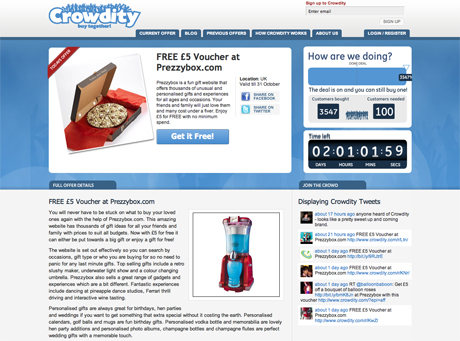
From the back of a fag packet idea in January this year to the launch on 11 May, Battersea-based Crowdity has already built a base of 35,000 active users and is aiming for 350,000 within a year.

Chief executive and founding partner Robert Berrisford employs six staff and funds the company privately.

Crowdity chief executive Robert Berrisford

Crowdity chief executive Robert Berrisford

• What’s your pitch?
“We are a group buying website, so if we can get 50 people to sign up to get a hair cut everyone gets it half price. We bring people together to buy, meaning we can go to businesses and negotiate a large discount that you wouldn’t be able to get alone.”

• How do you make money?
“We take a fee from the businesses we feature on the site.”

• How are you surviving the downturn?
“The downturn is perfect for us because people are willing to put in more work to get a bargain.”

• What’s your background?
“I have always worked in online marketing, starting out at toptable.co.uk and them moving on to head up a substantial PPC and search engine optimisation company.”

• What makes your business unique?
“We allow people to save by using their social circle and social media connections.”

• What has been your biggest achievement?
“We have done some pretty crazy numbers so far, giving out over 15,000 Seatwave vouchers in seven days.”

• Who in the tech business inspires you?
“I am a huge Spotify fan. I love the way they took on the music business and forced them to change the way they think about how they distribute their product.”

• What’s your biggest challenge?
“In finance, we are competing with some very well funded companies coming in from the States, like Groupon, so we have to be smarter and more nimble to compete with their spending power.”

• What’s the most important piece of software or web tool that you use each day?
MSN Messenger. It’s old school, but half of the people in tech still use it so it is good to keep in touch internally and externally.”

• Name your closest competitors
groupon.co.uk

• Where do you want the company to be in five years?
“We should be competing in most of the biggest cities in the world, if everything goes to plan.”

• Sell to Google, or be bigger than Google?
“I am not sure many companies will ever be up there with Google, but way too many start ups launch with a sale in mind. I would settle for a highly profitable business.”

crowdity.co.uk

crowdity.co.uk

Graph of top 1000 websites captures ‘long tail’ of the internet

Pingdom graph shows you need at least 22m visitors per month to break into Top 100 websites

Pingdom graph and the remarkable ‘long tail’ of the top 100 websites

Using data from Google’s top 1000 sites list, Royal Pingdom have put together this fascinating graphic showing just what it takes to make it to the top of the internet pile.

The graphic above shows that to break into the totemic top 100, your website needs to be pulling in a not inconsiderable 22m unique visitors a month. Take those 22m visitors, add at least another 78m and your website will sit pretty in the top 13.

Pingdom graph shows you need at least 22m visitors per month to break into Top 1000 websites

At least 3.8m unique visitors per month will currently see your website into the top 1000 – a couple million more could see you jump 250 places

Altogether, the top 10 websites attract 2.78bn visitors per month – that’s 42% of all visitors to the top 100. See the full list on Royal Pingdom .

Top 1000 websites by monthly unique visitors

1. Facebook.com – 540m
10. Mozilla.com – 110m
25. Hotmail.com – 60m
50. Sogou.com – 37m
100. Thepiratebay.com – 21m
200. Typepad.com – 13m
300. Ourtoolbar.com – 9.8m
400. Zhaopin.com – 8.1m
500. The2009.cn – 6.8m
750. Marriott.com – 5m
1000. Trialpay.com – 3.8m

Advanced Entrepreneurship: Silence Isn’t Golden; It’s Dangerous – Harvard Business Review

In large companies, the CEO has professional writers, a PR office, and lots of other skilled people on hand to help relay important messages to the right constituents. As a CEO of a start-up, you don’t have this luxury. You are always the company’s #1 Communicator.

Most important is to never underestimate this role. Silence isn’t golden; it’s dangerous. Even if there’s no good news to share, say something! At first, employees and investors will fill your silence with their fondest hopes. But once you’ve missed a single deadline, or something hasn’t gone according to plan, everyone will project their worst fears into the void.

Communication is even trickier now with social media. For example, one CEO stopped sending updates to investors, but chronicled his weeklong camping trips and conference excursions on Facebook, all while the company’s cash reserves (paying his five-figure-a-month salary) dwindled. As you can imagine, his investors followed his adventures with, how shall I say it, avid interest.

But enough about how not to communicate; here’s how a great entrepreneur CEO should communicate.

Communicate Vision, Strategy, and Direction…Often
As CEO, your primary duty is to set strategy and vision for the company, but it’s not enough to simply do so in your own mind. You have to impart that vision to your employees so they can help carry it out.

At a new employee orientation in 1991 — when Intuit had just 120 employees and one product — then-CEO Scott Cook made sure each of the fledgling company’s employees knew his plans for building the firm and what was needed to move the company toward the future he envisioned for it. It’s no coincidence that 20 years later Intuit has grown into a billion-dollar company with thousands of employees and dozens of products.

Communicate with Your Investors
Of course, most CEOs of start-ups find themselves far richer with ideas than money, so they also have to communicate their vision to potential investors. Part of effectively communicating includes efficiently communicating. You never know when you’ll need to give a quick pitch during an elevator ride, or be able to succinctly sell an investor on your idea’s economic or social return.

That’s how Tom Tuohy launched his non-profit, Dreams for Kids, in December 1989. A few weeks before Christmas, a friend told Tuohy of her grief that 54 children in the local homeless shelter wouldn’t be receiving Christmas gifts. In under a month, Tuohy organized a dozen volunteers and delivered gifts and food to the shelter on Christmas Eve, and Dreams for Kids was born.

Two decades later, Dreams for Kids helps empower economically disadvantaged and physically challenged kids in all kinds of ways (“Extreme Recess” is my personal favorite). Having helped more than 28,000 children, Tuohy’s ability to convince others to invest in Dream for Kids is crucial to its success.

Communicate with Your Customers
Customers also want to hear from the CEO. They want to know your product is better than your competitors’. They want to know you’ll still be in business to service that product a year from now. And they want to know you’re listening. Especially if you’re in a B2B business where purchases are expensive and the product is critical to your customer’s success.

The bottom line is that whether dealing with employees, investors, customers, partners, or even suppliers and vendors, a great entrepreneur CEO is always communicating. To master this job, you need to make sure you’re sending the messages that keep everyone moving together to make the company a success.

Stever Robbins is a serial entrepreneur, top-10 iTunes business podcaster (“The Get-it-Done Guy”), and CEO of Stever Robbins, Inc., an entrepreneurial consulting and coaching firm. He teaches at Babson College on building social capital. His first book, The Get-it-Done Guy’s 9 Steps to Work Less and Do More, is coming out this September.


TweetDeck Arrives on Android

Starting this Thursday, popular social media management tool TweetDeck will be available as an Android app. The company is opening its beta program in the morning, and we were lucky enough to get our hands on a copy tonight.

We’ve tried other Android apps that have promised varying degrees of functionality and features for social media work and play; we’ve experienced varying degrees of satisfaction so far with all of them.

The TweetDeck app for Android is still “very beta,” a.k.a. lacking the polish you’d expect from a completely finished application. We tried playing around with it a bit tonight; while we’ll be delighted when more mature builds are available, we still think the app has breathtaking potential.

It integrates Facebook, Twitter, Buzz and Foursquare accounts into a single application. Updates are color-coded and presented in a single, blended column. There’s also a “Me” column for reviewing all your Twitter @replies and comments and like for your Facebook posts.

To give you an idea of what the app will look like, here are the signin and Home screens:

And here’s what a Foursquare venue screen and Twitter profile page look like:

Overall, the UI is clean and optimized for mobile displays — and the way updates are pulled is easier on battery life than having a constantly running, real-time stream of data.

And we’ve got to hand it to the developers and designers at TweetDeck for giving Android users even more fun and useful features than are currently available on the iPhone version of TweetDeck, which doesn’t yet support Foursquare or Buzz. But this Android app is a clear signal of where the company’s Apple-focused applications will be headed.

In future iterations of the app, TweetDeck hopes to add improved map performance, better handling for multiple Twitter accounts, video upload capabilities and better integration with Android hardware.

Check the company’s website in a few more hours for details on how you can be part of its Android beta program, and definitely let us know what you think of the app in the comments.