The Periodic Table Of SEO Ranking Factors, used with permission
[youtube http://www.youtube.com/watch?v=rAWFv43qubI]
More companies are seeing the benefits of online lead generation (OLG), with budgets rising, and a greater proportion of offline sales coming from online activity.
The proportion of companies who are generating leads online with the intention of converting them offline has increased from 70% last year to 81% this year, while on average OLG is responsible for 42% of total sales, up from 40% last year.
These are some of the findings from Econsultancy’s Online Lead Generation Report 2010 (B2C), produced in association with Clash Media. More highlights from the report after the jump…
Online lead generation methods used
Search engine optimisation (SEO) is still the most widely used channel for generating leads online, and this has continued to grow, with the percentage using search engine optimisation up by 13% to 90% this year.
Email marketing (to in-house lists) is the second most widely used online lead generation method, up from 74% last year to 83% this year, followed by PPC on 73%.
Naturally, given the ubiquity of the subject, there has been a big increase in the use of social media for OLG. 66% of companies surveyed are using this channel to generate consumer leads, compared to 40% last year.
There has also been an increase in the use of rich media and video, while RSS is the only method on the wane, down 2% on 2009.
Lead generation budgets
The increasing importance of OLG is reflected in the allocation of budgets. The number of companies who say that OLG budgets have gone up in the last year has increased from 59% last year to 65% this year. This compares to 31% of respondents who say that offline lead generation budgets have increased.
38% of companies surveyed are now spending at least £100,000 annually on online lead generation. Last year, only 21% of companies surveyed said they were spending this amount or more.
The proportion of lead generation budgets targeted online has dropped slightly from last year’s survey, though still roughly the same:
Measurement
Measuring the effectiveness of online lead generation is an on-going problem, with only 32% saying they are either “excellent” (8%) or “good” (24%) at this. There are still significant numbers of advertisers who say they are only “average” (22%), “poor” (17%) or “very poor” (3%). There has not been any significant improvement since 2009.
How online leads are converted
Advertisers are most likely to convert online leads through email and online transactions (85%) and telephone calls (67%), followed by social media (23%) and stores (16%).
Since last year there has been a significant increase in the proportion of respondents using these email and telephone for lead conversion, by 10% and 9% respectively
Google has acquired Metaweb, an internet information database company, in a bid to “improve its search” offering.
 Google is on an acquisition spree having bought Metaweb and ITA, a flight information software company, during the last two weeks. Photo: AFP
The search giant announced its acquisition late on Friday evening (July 16) via its company blog. Jack Menzel, director of product management at Google, wrote: “We’ve acquired Metaweb, a company that maintains an open database of things in the world. Working together we want to improve search and make the web richer and more meaningful for everyone.
“With efforts like ‘rich snippets’ and the ‘search answers feature’, we’re just beginning to apply our understanding of the web to make search better. Type [Barack Obama birthday] in the search box and see the answer right at the top of the page. Or search for [events in San Jose] and see a list of specific events and dates. We can offer this kind of experience because we understand facts about real people and real events out in the world.
“But what about [colleges on the west coast with tuition under $30,000] or [actors over 40 who have won at least one Oscar]? These are hard questions, and we’ve acquired Metaweb because we believe working together we’ll be able to provide better answers.”
Metaweb had raised $15 million in funding in 2006, followed by another $42.5 million in 2008. At the time, too, the company garnered significant publicity and although it had subsequently become less prominent, industry sources indicate that Google has paid more than has been invested in the company. The terms of the deal were not disclosed
It has also been suggested that the move by the search giant, to bolster its core search operation, demonstrates that it is beginning to look at ways of augmenting the algorithmic methods it currently uses to provide search results.
Menzel added: “In addition to our ideas for search, we’re also excited about the possibilities for Freebase, Metaweb’s free and open database of over 12 million things, including movies, books, TV shows, celebrities, locations, companies and more.
“Google and Metaweb plan to maintain Freebase as a free and open database for the world. Better yet, we plan to contribute to and further develop Freebase and would be delighted if other web companies use and contribute to the data. We believe that by improving Freebase, it will be a tremendous resource to make the web richer for everyone. And to the extent the web becomes a better place, this is good for webmasters and good for users.”
Google is on something of an acquisition spree, having recently announced the $700 million cash acquisition of ITA, a flight information software company, in a bid to enter the lucrative digital travel market.
The search giant is hoping that the cash acquisition, the fourth largest in its history, will allow it to create bespoke search tools focused on travel. ITA, which has been in existence for 14 years, aggregates and organises information it gathers from travel agents and airlines, including flight times, ticket prices and availability.
However, the deal needs approval by the US competition authorities, as the acquisition would bring together the world’s largest search engine with one of the biggest pieces of travel search software.
Bing Has A New Look, Now Hosts Deep Content In Search Results
Jun 23, 2010 at 2:14am ET by Matt McGee
While Bing is throwing a star-studded party to announce changes to its entertainment-based search results, there are several other changes that deserve a close look, not the least of which is the amount of deep content — including full articles with thousands of words — that Bing is now hosting in its search results. More on that in a bit.
Look & Feel
Let’s start with the overall new look and feel that Bing has announced. The biggest change is that search options — or, Quick Tabs in Bing-speak — have been moved from the left-side column to immediately under the search box at the top of the page. Bing calls this the Answer Bar.
Just like before, the tabs will change depending on the query; the U2 search above has tabs for Songs, Albums, and Videos that are obviously query-specific. In order to make the Quick Tabs more visible below the search box, Bing’s background “image of the day” has been cut down in size pretty substantially, and you can barely tell what it is now. (If you care, that is.)
The left-side column, meanwhile, still has Related Searches and links to your recent searches; these are now easier to access because the Quick Tabs don’t take up several hundred vertical pixels above them.
What’s unchanged is the inclusion of categorized results further down the search results page.
But beyond the new Answer Bar at the top of the search results page, Bing has made some pretty substantial additions and changes to the search results for certain verticals, like Autos, Finance, and Health.
Bing: Autos
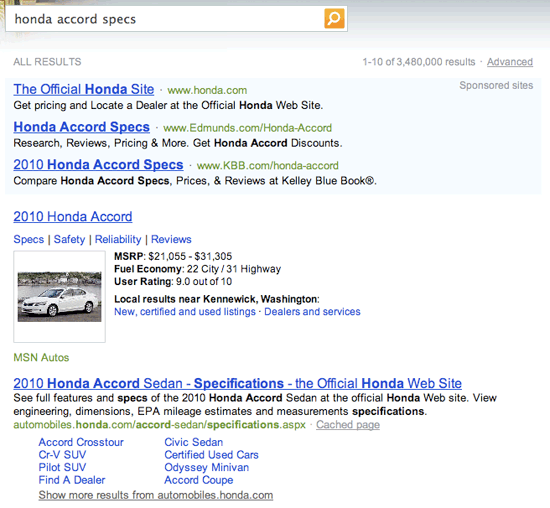
Consider a search for honda accord specs. On the old Bing interface, you’d get a pretty standard page of search results with a little bit of information about the car in Bing’s standard Instant Answer.
In the new interface, auto-related searches that include the word “specs” (and perhaps other terms; I haven’t been able to trigger it, though) send you directly to a new Quick Tab with what appears to be a pretty complete look at the Honda Accord’s specs.
The data comes from MSN Autos, and each of the orange headings you see above (Pricing & Warranty, Fuel Economy, etc.) links to further information at MSN Autos.
Bing: Finance
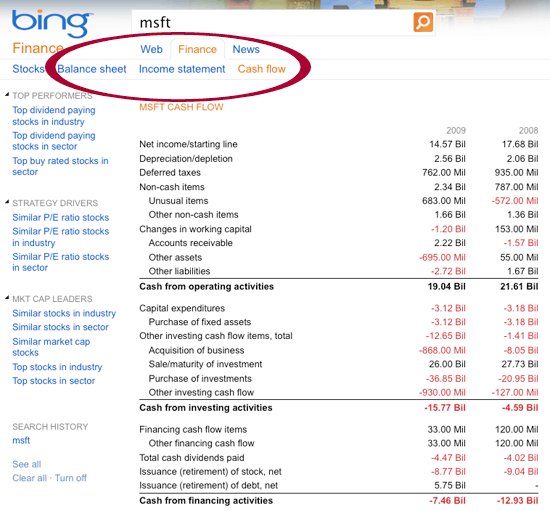
Bing has been strong in finance-related searches, and already shows a wealth of company information on searches that involve company stock ticker symbols. Do a search for MSFT and then click the “Finance” Quick Tab on the left, and you would see a page like this:
But, as part of the new interface, Bing has added several new content pages underneath the Finance Quick Tab that give investors faster access to deeper company information. You can see links (below) for Balance sheet, Income statement, and Cash flow — each one is a page of data like this:
Bing: Health
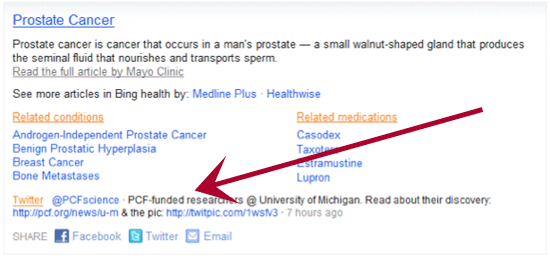
Coming later this week will be a variety of upgrades to Bing’s search results and interface for health-related searches. One is the addition of authoritative Twitter updates to the existing Instant Answer for medical conditions. Here’s a look at what the Instant Answer for prostate cancer will look like:
The tweet above comes from the Prostate Cancer Foundation. Bing says the tweets will only come from authoritative sources and will appear when relevancy and recency standards are met; the tweet above mentions a new discovery related to prostate cancer, which is a piece of information that the Instant Answer might not otherwise have shared with searchers.
More important than that, though, is Bing’s integration of content directly in the search results via partnerships with a variety of well-known health industry sources.
Do a search for diabetes, for example, and the initial search results include Bing’s standard Instant Answer. But there’s a new Health Quick Tab at the top of the page, and under that tab is a detailed article from the Mayo Clinic.
There’s also a box for “related articles,” all of which link to additional articles hosted by Bing.
Bing has had health information from the Mayo Clinic (and others) in its Instant Answers since day one, but this is much more than Instant Answers. This is full content articles acting like a search results page (or tab, in this case). How detailed and lengthy is that Mayo Clinic article on Bing? It’s a collection of the 10 articles that appear on the Mayo Clinic’s diabetes page — mirroring the ten links on the left side of that page (Definition, Symptoms, Causes, etc.). I cut-and-pasted Bing’s version into Microsoft Word: It took up eight pages and shows a word count of 5,264.
Final Thoughts
With this latest round of changes, Bing continues to drive home the idea of being a “decision engine” — getting searchers the information they need to take action right from the search results, or with as few clicks as possible from the search results.
Bing says that the new Answer Bar increased user engagement during its internal testing, and also helped to decrease the number of manual re-queries. Bing says that’s a sign that searchers are getting the information they need.
What’s very important in all of this, I think, is the increase in real information sitting on/in Bing’s search engine — the type of stuff search engines typically just provide links to. Whether it’s full specs for a new car, a company’s complete and current balance sheet, or an 8,000+ word article about diabetes, this is new. Search results are now content.
Note: Some Bing users may not see all of the changes at this time while the updates are rolling out; the Health updates, in particular, aren’t due to go live for a couple days.
Bing’s still hated though